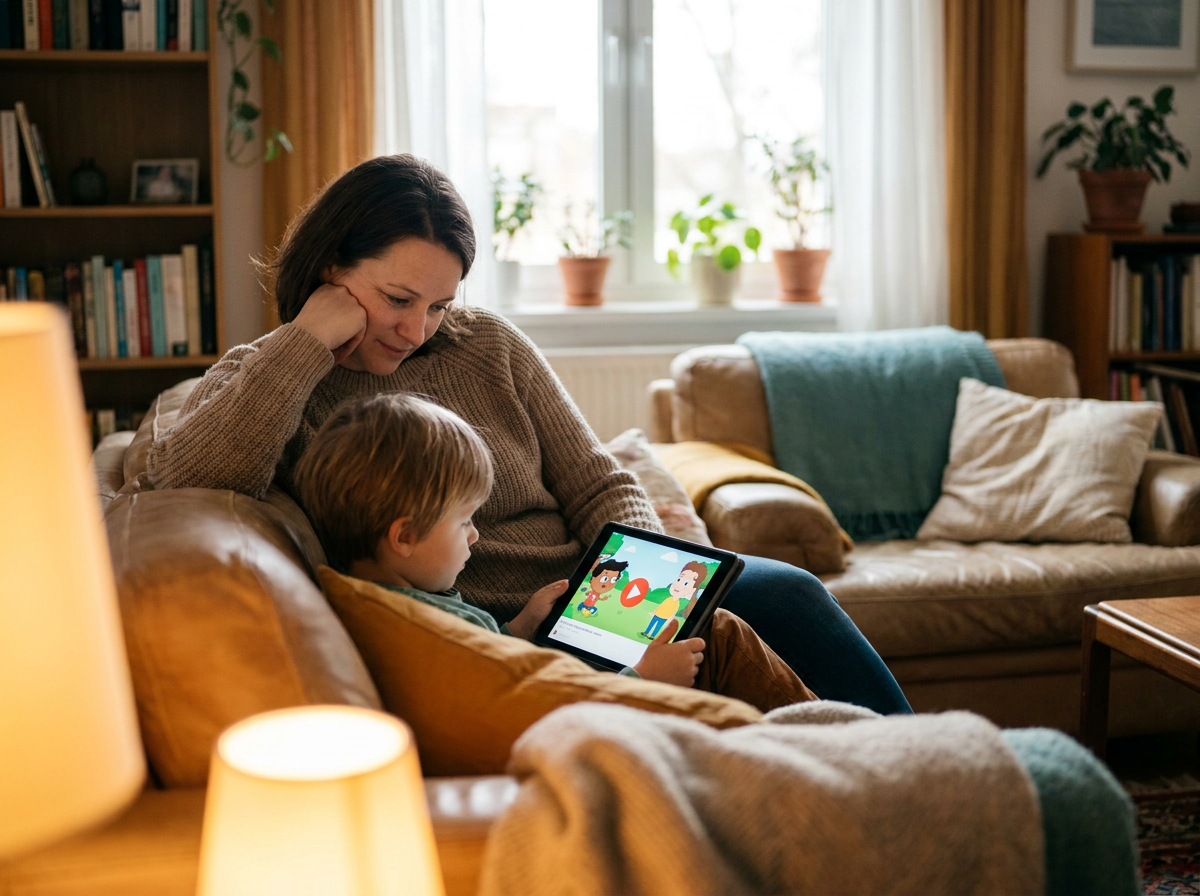
If you hand your toddler a screen to calm them, you are not alone. But a new study says how we use screens matters more than we thought.
Your toddler is melting down because the banana broke, you said "no" to something, it is time to leave the park, or they are tired, hungry, and overstimulated. In that moment, a phone or tablet can feel like the only thing that works.
No judgment: screens are incredibly effective at capturing attention. But a brand-new UC Irvine-led study is a helpful wake-up call.
Want scripts and calm-down alternatives ready to go? Try Digital Age Parenting free
What the New UC Irvine Study Found (in Plain English)
According to a UC Irvine news release about a study published in Developmental Psychology, researchers followed 210 families from when children were 9 to 30 months old.
Finding #1
Using digital devices to calm or distract very young children was linked to increased behavior problems over time.
Finding #2
For mothers, higher parenting stress was linked to more frequent device use to calm children.
Finding #3
That pattern was associated with more toddler behavior problems, which then linked back to higher stress over time.
In other words, it can become a loop: parent stress goes up, screens get used to calm, behavior challenges increase, parent stress goes up even more.
Important: The researchers emphasized that the study does not prove causation. But it highlights a pattern worth paying attention to.
Why "Screens as a Calming Tool" Can Backfire Long-Term
This is not about screens being "bad." It is about what gets replaced. The UC Irvine team explained the concern as displacement: when a screen steps in during big feelings, it can replace the moments where toddlers practice self-regulation.
Toddlers are not born knowing how to calm down. They learn it through repeated, supported experiences: being held, being coached, being redirected, being offered choices, being helped to name feelings. When a screen becomes the main strategy, toddlers may get fewer reps at building those skills.
The goal is not "never screens." It is "don't let screens be the only calm-down tool."
What to Do Instead: A Realistic 3-Step Calm-Down Plan
No perfection required. Just a simple, repeatable plan you can start today.
Regulate first (30 seconds)
Before you try to fix your toddler's feelings, help their body feel safe. Get down at their level. Offer a hug (or a little space). Slow your voice. Take 1 to 2 deep breaths where they can see you.
Script: "You're having a hard time. I'm here."
Name + boundary (10 seconds)
Toddlers calm faster when they feel understood and the boundary is clear.
Script: "You're mad because you want the phone. The phone is not for calming."
Offer a calm-down choice
Choices give toddlers a sense of control without giving in. Try: "Do you want a hug or space?" "Do you want to stomp 5 times or squeeze your pillow?" "Do you want water or a snack?" "Do you want to sit on the couch or in your cozy spot?"
Script: "Do you want a hug or space?"
A Screen-Free Calm-Down Menu for Toddlers (Save This)
Keep this list somewhere easy. These are fast, low-effort options that work well for ages 1 to 3.
Snack + water (hanger is real)
Step outside for 60 seconds
Heavy work: wall pushes, carrying a small basket, pushing a laundry hamper
Sensory reset: warm washcloth on face, bubble blowing, play dough
Connection reset: 2 minutes of floor play (you follow their lead)
Transition object: a small toy they hold while moving to the next activity
When It Is Okay to Use a Screen
Real life is real life. If you need a screen sometimes (travel, illness, a work call, survival mode), you can reduce the "calm-down association" by changing the framing. Instead of screen = comfort, try screen = planned activity.
Script: "We are going to watch one show after lunch. Right now, I am helping your body calm down."
If You Are Thinking, "But Screens Are the Only Thing That Works..."
That is usually a sign of two things: your toddler is missing a consistent calm-down routine, and you are exhausted (and you deserve support).
Pick one calm-down choice you will use every time. Consistency builds the skill.
Repeat the same script. Same words = less negotiation.
Aim for progress, not purity. One less screen-as-comfort moment per day is a win.
Want This to Be Easier in the Moment?
Quick scripts for meltdowns and transitions, connection-first ideas that calm without giving in, and connection questions that build the bond even when your child is little.
Most apps control screens. We rebuild connection.
Try Digital Age Parenting FreeSource: UC Irvine News, "Parental reliance on digital devices to calm youngsters is linked to behavior problems" (Apr 23, 2026). Study published in Developmental Psychology.